Ensemble Kalman Filter (EnKF)
The Ensemble Kalman Filter uses an ensemble of state vectors to represent the probability distribution, computing the Kalman gain from sample covariances. It is ideal for high-dimensional systems where maintaining a full covariance matrix is impractical.
Fundamental Concepts
The Idea
Instead of tracking a single state + full covariance matrix (\(n \times n\)), the EnKF maintains \(N\) ensemble members (state samples). Statistics are computed from the ensemble:
The Algorithm
Predict: Propagate each ensemble member + add noise
Update (Stochastic EnKF): Perturb observations and update each member
where \(\epsilon^{(i)} \sim \mathcal{N}(0, R)\) are observation perturbations.
When to Use
| ✅ Use EnKF when | ❌ Don't use when |
|---|---|
| State dimension is high (\(n > 10\)) | State dimension is small (UKF is more accurate) |
| Full covariance is too expensive | Need exact Bayesian solution (use PF) |
| System is non-linear | Noise is strongly non-Gaussian |
How to Use
import numpy as np
from kalbee import EnsembleKalmanFilter

state = np.array([[0.0], [0.0]])
cov = np.eye(2) * 10.0
Q = np.eye(2) * 0.01
R = np.eye(1) * 0.5

def transition(x, dt):
    F = np.array([[1, dt], [0, 1]])
    return F @ x

def measurement(x):
    return x[:1]  # Observe position

enkf = EnsembleKalmanFilter(
    state, cov, Q, R,
    transition_function=transition,
    measurement_function=measurement,
    ensemble_size=100,
)

np.random.seed(42)
for t in range(1, 11):
    enkf.predict(dt=1.0)
    z = np.array([[float(t) + np.random.randn() * 0.5]])
    enkf.update(z)
    print(f"True: {t}  Estimated: {enkf.x[0,0]:.2f}")
Run an Experiment
from kalbee import run_experiment

report = run_experiment(
    signal="sine",
    filters=["kf", "ukf", "enkf"],
    noise_std=0.3,
    duration=10.0,
    seed=42,
)
print(report.summary())
Ensemble Size
The experiment runner uses 100 ensemble members by default. Increasing this improves accuracy but slows execution. For most problems, 50–200 is sufficient.
Simulation Results
Here is the tracking performance of the Ensemble Kalman Filter (EnKF) compared against the Standard Kalman Filter baseline on three different signal trajectories:
1. Sine/Cosine Signal
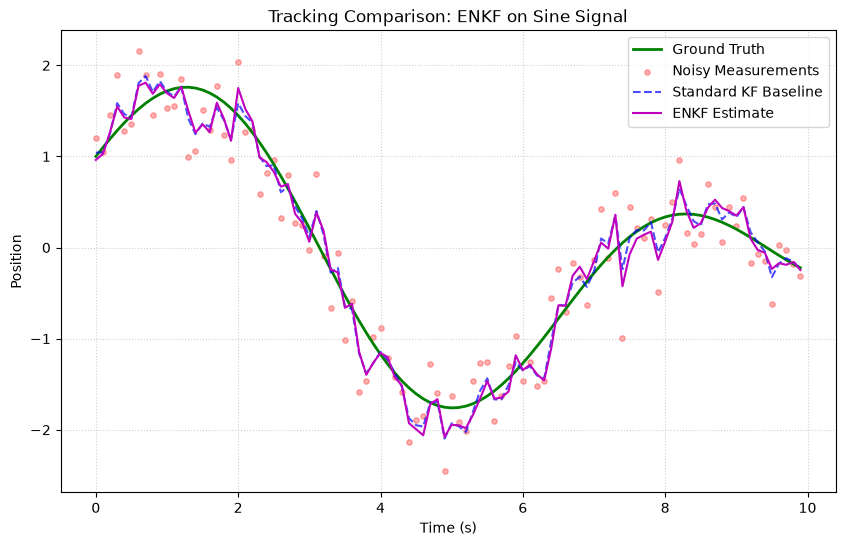
- Analysis: The EnKF propagates an ensemble of 30 members. Due to this sample-based covariance approximation, its trajectory displays slightly more fluctuations compared to the analytical Standard KF baseline.
2. Polynomial (Degree 2) Signal
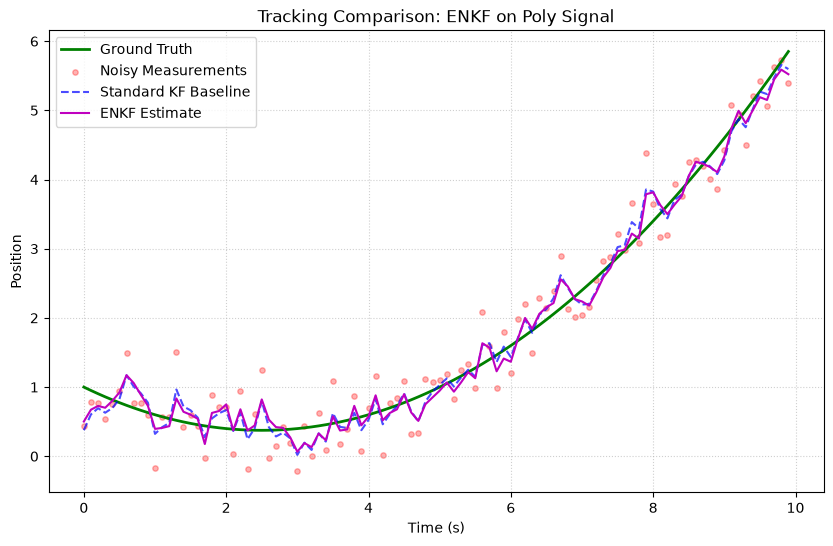
- Analysis: EnKF follows the quadratic curve but is bounded by the same constant-velocity model lag as the standard KF. The ensemble mean matches the baseline track.
3. Random Walk Signal
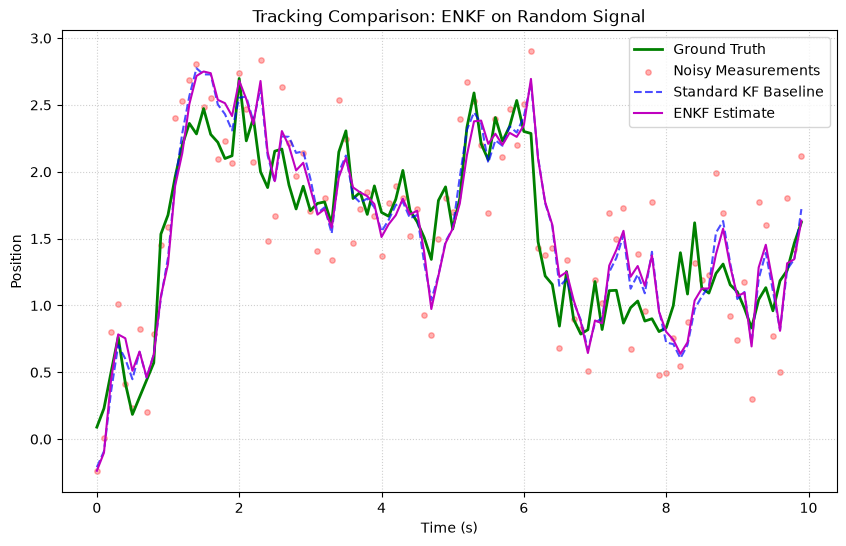
- Analysis: EnKF tracks the stochastic walk smoothly, confirming that ensemble covariance estimation scales stably under random noise perturbations.