Unscented Kalman Filter (UKF)
The Unscented Kalman Filter handles non-linear systems without Jacobians. Instead of linearizing, it uses a deterministic sampling technique called the Unscented Transform to capture the true mean and covariance to higher accuracy.
Fundamental Concepts
The Problem with Linearization
The EKF linearizes non-linear functions, which introduces error. For highly non-linear systems, this approximation can diverge. The UKF takes a fundamentally different approach:
"It is easier to approximate a probability distribution than to approximate a non-linear function."
The Unscented Transform
Instead of linearizing \(f(x)\), the UKF:
- Generates sigma points — a small set of carefully chosen sample points around the mean
- Propagates each point through the true non-linear function
- Reconstructs the mean and covariance from the transformed points
For a state of dimension \(n\), we generate \(2n + 1\) sigma points:
Where \(\lambda = \alpha^2(n + \kappa) - n\) controls the spread.
Tuning Parameters
| Parameter | Default | Role |
|---|---|---|
| \(\alpha\) | 0.001 | Spread of sigma points (small = tight around mean) |
| \(\beta\) | 2.0 | Prior distribution knowledge (2 = optimal for Gaussian) |
| \(\kappa\) | 0.0 | Secondary scaling parameter |
When to Use
| ✅ Use UKF when | ❌ Don't use when |
|---|---|
| System is highly non-linear | System is linear (KF is simpler and faster) |
| Jacobians are hard to derive | Noise is non-Gaussian (use PF) |
| Need better accuracy than EKF | State dimension is very high (use EnKF) |
| Noise is Gaussian | — |
How to Use
Example: Non-linear Measurement (\(z = x^2\))
import numpy as np
from kalbee import UnscentedKalmanFilter

state = np.array([[2.0]])
covariance = np.eye(1) * 0.1
Q = np.eye(1) * 0.01
R = np.eye(1) * 0.01

# Just provide the functions — no Jacobians needed!
def transition(x, dt):
    return x  # Static state

def measurement(x):
    return x ** 2  # Non-linear measurement

ukf = UnscentedKalmanFilter(
    state, covariance, Q, R,
    transition_function=transition,
    measurement_function=measurement,
    alpha=0.001,
    beta=2.0,
    kappa=0.0,
)

# Track
np.random.seed(42)
true_state = 2.0

for _ in range(10):
    ukf.predict(dt=1.0)
    z = np.array([[true_state**2 + np.random.randn() * 0.1]])
    ukf.update(z)
    print(f"True: {true_state:.2f}  Estimated: {ukf.x[0,0]:.4f}  "
          f"Covariance: {ukf.P[0,0]:.6f}")
2D Tracking Example
import numpy as np
from kalbee import UnscentedKalmanFilter

# State: [x_pos, y_pos, x_vel, y_vel]
state = np.zeros((4, 1))
cov = np.eye(4) * 10.0
Q = np.eye(4) * 0.1
R = np.eye(2) * 1.0  # Measure both positions

def transition(x, dt):
    F = np.array([[1, 0, dt, 0],
                  [0, 1, 0, dt],
                  [0, 0, 1, 0],
                  [0, 0, 0, 1]])
    return F @ x

def measurement(x):
    return x[:2]  # Observe [x_pos, y_pos]

ukf = UnscentedKalmanFilter(state, cov, Q, R, transition, measurement)
Run an Experiment
from kalbee import run_experiment

report = run_experiment(
    signal="sine",
    filters=["kf", "ekf", "ukf"],
    noise_std=0.5,
    duration=10.0,
    seed=42,
)
print(report.summary())

# UKF typically matches or outperforms EKF on non-linear signals
UKF vs EKF
The UKF captures the statistics of non-linear transformations more accurately (up to 2nd order for Gaussian) compared to EKF (1st order only). The trade-off is slightly higher computation due to sigma point propagation.
Simulation Results
Here is the tracking performance of the Unscented Kalman Filter (UKF) compared against the Standard Kalman Filter baseline on three different signal trajectories:
1. Sine/Cosine Signal
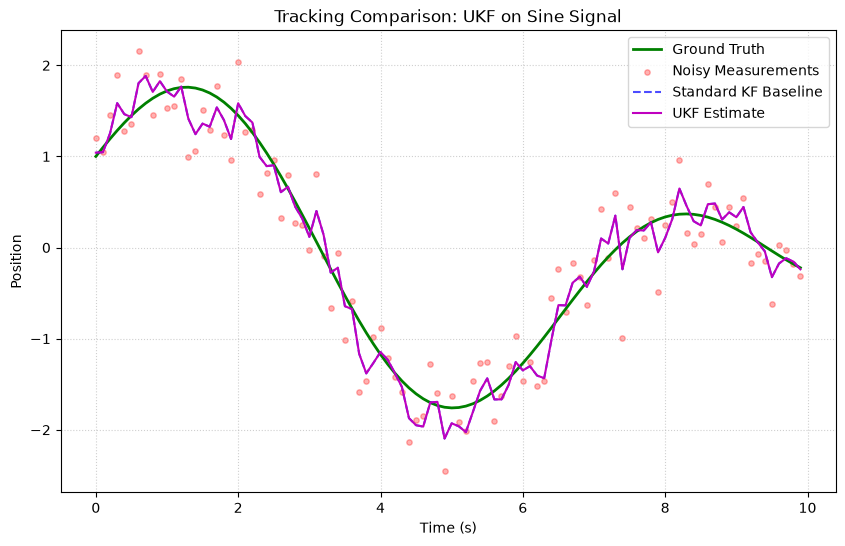
- Analysis: Under linear setups, the UKF's sigma points propagate the Gaussian state distribution exactly, matching the baseline Kalman Filter.
2. Polynomial (Degree 2) Signal
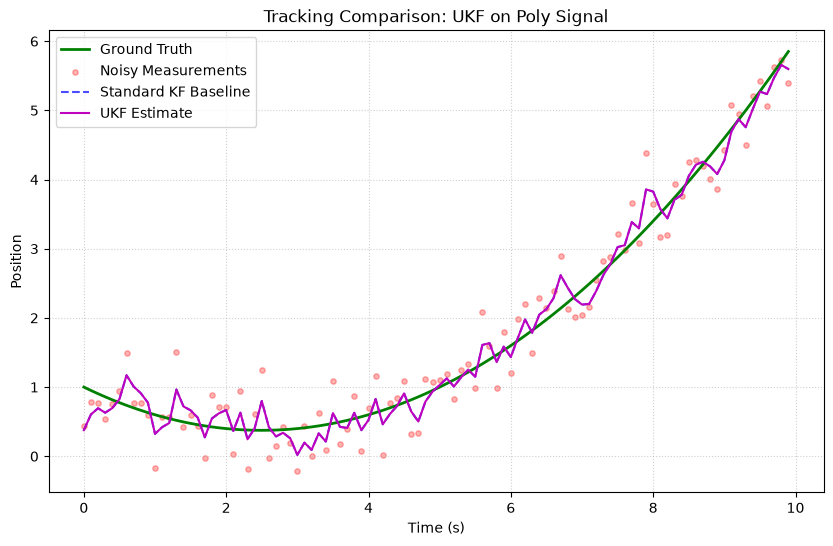
- Analysis: Like the standard KF, the UKF exhibits a steady-state lag during polynomial tracking since the constant velocity model is used.
3. Random Walk Signal
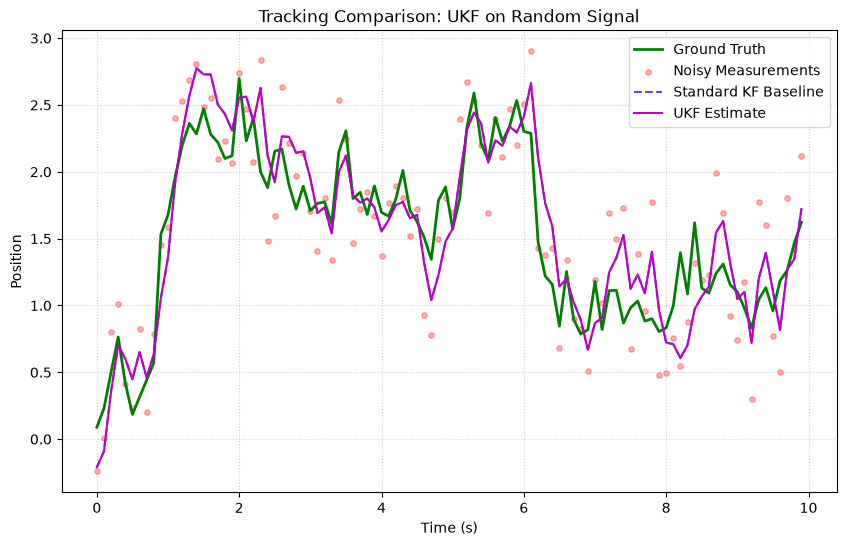
- Analysis: The UKF matches the baseline KF, confirming that the Unscented Transform behaves stably in the presence of random walks.