Kalman Filter (KF)
The Standard Kalman Filter is the foundational algorithm for state estimation in linear systems with Gaussian noise. It is optimal in the minimum mean-square error sense.
Fundamental Concepts
The Problem
You have a system that evolves over time:
Where:
- \(x_k\) is the state (what you want to estimate, e.g., position + velocity)
- \(z_k\) is the measurement (what your sensor reads)
- \(F\) is the transition matrix (how state evolves)
- \(H\) is the measurement matrix (what you observe from the state)
- \(w_k \sim \mathcal{N}(0, Q)\) is process noise
- \(v_k \sim \mathcal{N}(0, R)\) is measurement noise
The Algorithm
The KF operates in two steps each cycle:
Predict — project state forward:
Update — correct with measurement:
Joseph Form
kalbee uses the Joseph form for the covariance update (last equation). This is more numerically stable than the simpler \(P = (I-KH)P\), preventing \(P\) from losing symmetry or positive-definiteness.
When to Use
| ✅ Use KF when | ❌ Don't use when |
|---|---|
| System dynamics are linear | Dynamics are non-linear (use EKF/UKF) |
| Noise is Gaussian | Noise is non-Gaussian (use Particle Filter) |
| You know F, H, Q, R | Model is unknown or switches (use Adaptive KF) |
| Real-time performance needed | — |
How to Use
Basic Example: Tracking Position and Velocity
import numpy as np
from kalbee import KalmanFilter

# State: [position, velocity]
state = np.array([[0.0], [0.0]])
covariance = np.eye(2) * 10.0  # High initial uncertainty

# Constant-velocity model
dt = 1.0
F = np.array([[1.0, dt],
              [0.0, 1.0]])   # position += velocity * dt
Q = np.eye(2) * 0.01          # Small process noise
H = np.array([[1.0, 0.0]])    # Measure position only
R = np.array([[0.5]])          # Measurement noise variance

kf = KalmanFilter(state, covariance, F, Q, H, R)

# Simulate noisy measurements of a target moving at velocity 1.0
true_positions = [1.0, 2.0, 3.0, 4.0, 5.0, 6.0, 7.0, 8.0, 9.0, 10.0]
np.random.seed(42)

for pos in true_positions:
    kf.predict(dt=dt)
    z = np.array([[pos + np.random.randn() * 0.5]])  # Noisy measurement
    kf.update(z)
    print(f"True: {pos:.1f}  Measured: {z[0,0]:.2f}  "
          f"Estimated: {kf.x[0,0]:.2f}  Velocity: {kf.x[1,0]:.2f}")
Using Properties
# Access state and covariance via properties
print(kf.x)     # State estimate (same as kf.state)
print(kf.P)     # Covariance (same as kf.covariance)

# Map state to measurement space
expected_measurement = kf.measure()
Run an Experiment
Compare the Kalman Filter against other filters on a synthetic curve:
from kalbee import run_experiment

report = run_experiment(
    signal="sine",                  # Track a sine wave
    filters=["kf", "ekf", "ukf"],  # Compare these filters
    noise_std=0.5,                  # Measurement noise level
    duration=10.0,
    seed=42,
)
print(report.summary())

# Access individual result
kf_result = report.results[0]
print(f"KF Position RMSE: {kf_result.position_rmse():.4f}")
print(f"KF Velocity RMSE: {kf_result.velocity_rmse():.4f}")
Signal Options
Try different signals: "sine", "cosine", "linear", "step" to see how the KF handles different dynamics. The KF excels on linear signals (constant velocity) but struggles with non-linear oscillations.
Simulation Results
Here is the tracking performance of the Standard Kalman Filter (KF) compared against the baseline on three different signal trajectories:
1. Sine/Cosine Signal
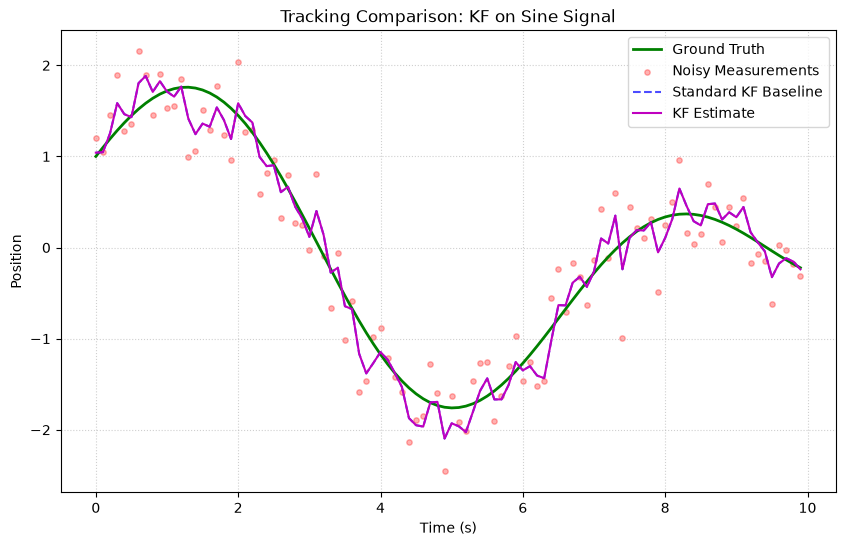
- Analysis: The standard KF tracks the oscillating sine wave with a small phase lag. Because the transition model assumes a constant velocity, it cannot predict the changing acceleration at the peaks and troughs.
2. Polynomial (Degree 2) Signal
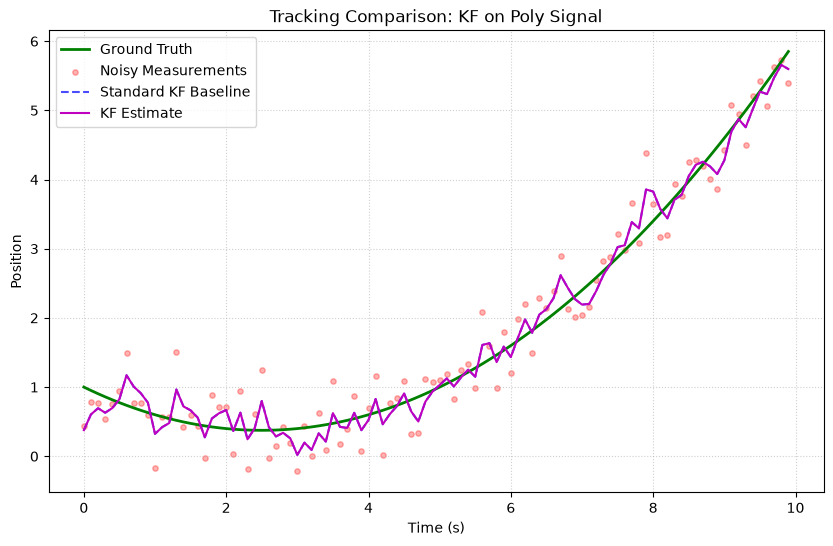
- Analysis: Under constant acceleration (quadratic curve), the CV Kalman Filter shows a steady-state lag. The estimated position lags behind the true position because the acceleration parameter is not modeled.
3. Random Walk Signal
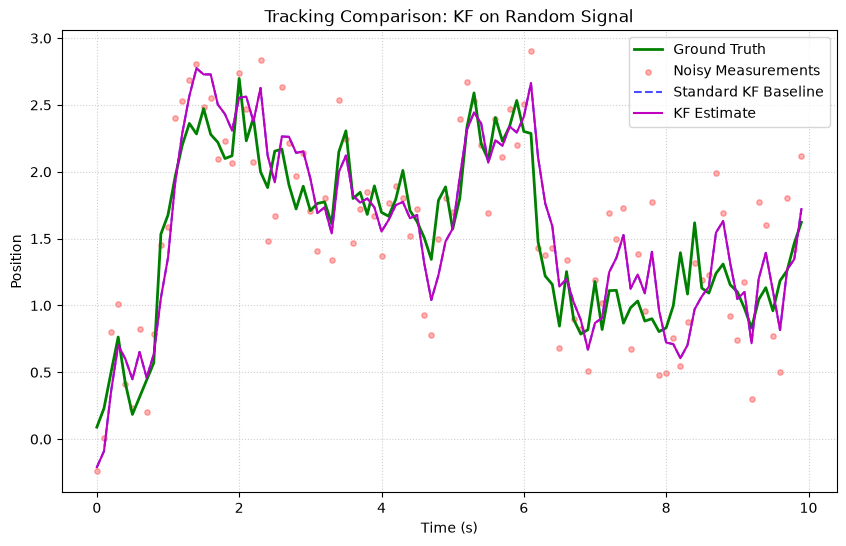
- Analysis: The filter smooths out the high-frequency measurement noise while following the random drift of the true state, acting as a balanced low-pass filter.