Extended Kalman Filter (EKF)
The Extended Kalman Filter extends the standard KF to handle non-linear systems by linearizing the dynamics using Jacobian matrices at each time step.
Fundamental Concepts
The Problem
Real-world systems are often non-linear:
Where \(f\) and \(h\) are non-linear functions. The standard KF cannot handle this directly because it assumes linearity.
The Solution: Linearization
The EKF approximates the non-linear functions using a first-order Taylor expansion around the current estimate:
Where \(F = \frac{\partial f}{\partial x}\bigg|_{\hat{x}}\) is the Jacobian matrix.
The Algorithm
Predict:
Update:
Jacobian Required
The EKF requires you to compute Jacobians (\(F\) and \(H\)) analytically. If your system is highly non-linear, this linearization can introduce significant error — consider using the UKF instead.
When to Use
| ✅ Use EKF when | ❌ Don't use when |
|---|---|
| System is mildly non-linear | System is highly non-linear (use UKF) |
| You can compute Jacobians | Jacobians are hard to derive (use UKF) |
| Noise is Gaussian | Noise is non-Gaussian (use PF) |
| Need to be close to the standard KF | — |
How to Use
Example: Non-linear Measurement (\(z = x^2\))
import numpy as np
from kalbee import ExtendedKalmanFilter

# State: single variable
state = np.array([[2.0]])
covariance = np.eye(1) * 1.0
Q = np.eye(1) * 0.01
R = np.eye(1) * 0.1

# Non-linear functions
def f(x, dt):
    """State transition: constant state."""
    return x

def F_jacobian(x, dt):
    """Jacobian of f: df/dx = I."""
    return np.array([[1.0]])

def h(x):
    """Measurement function: z = x^2."""
    return x ** 2

def H_jacobian(x):
    """Jacobian of h: dh/dx = 2x."""
    return np.array([[2 * x[0, 0]]])

# Initialize EKF
ekf = ExtendedKalmanFilter(
    state, covariance, Q, R,
    transition_function=f,
    measurement_function=h,
    transition_jacobian=F_jacobian,
    measurement_jacobian=H_jacobian,
)

# Simulate
np.random.seed(42)
true_state = 2.0

for _ in range(10):
    ekf.predict(dt=1.0)
    z = np.array([[true_state**2 + np.random.randn() * 0.1]])
    ekf.update(z)
    print(f"True: {true_state:.2f}  Estimated: {ekf.x[0,0]:.4f}")
Passing Functions via kwargs
You can also pass functions dynamically:
ekf = ExtendedKalmanFilter(state, covariance, Q, R)

# Pass functions at call time
ekf.predict(dt=0.1, f=my_transition, F=my_jacobian)
ekf.update(measurement, h=my_measurement, H=my_meas_jacobian)
Run an Experiment
from kalbee import run_experiment

# Compare EKF with other filters on a sine wave
report = run_experiment(
    signal="sine",
    filters=["kf", "ekf", "ukf"],
    noise_std=0.3,
    duration=10.0,
    seed=42,
)
print(report.summary())
EKF vs KF
On the sine signal, the EKF typically performs similarly to the KF because the experiment runner uses a constant-velocity model. The EKF's advantage shows when you have genuinely non-linear dynamics that cannot be captured by a linear \(F\) matrix.
Simulation Results
Here is the tracking performance of the Extended Kalman Filter (EKF) compared against the Standard Kalman Filter baseline on three different signal trajectories:
1. Sine/Cosine Signal
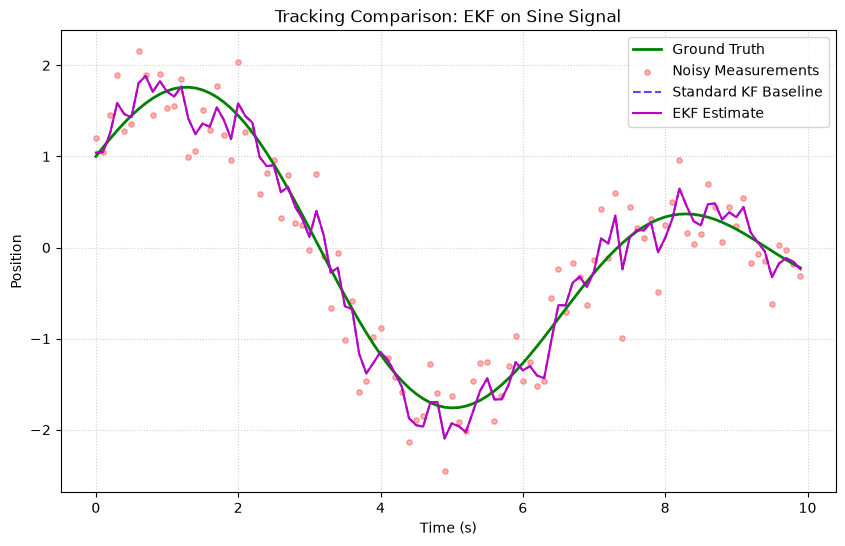
- Analysis: Because the underlying transition and measurement functions in this experiment are linear, the EKF performs identically to the standard KF baseline.
2. Polynomial (Degree 2) Signal
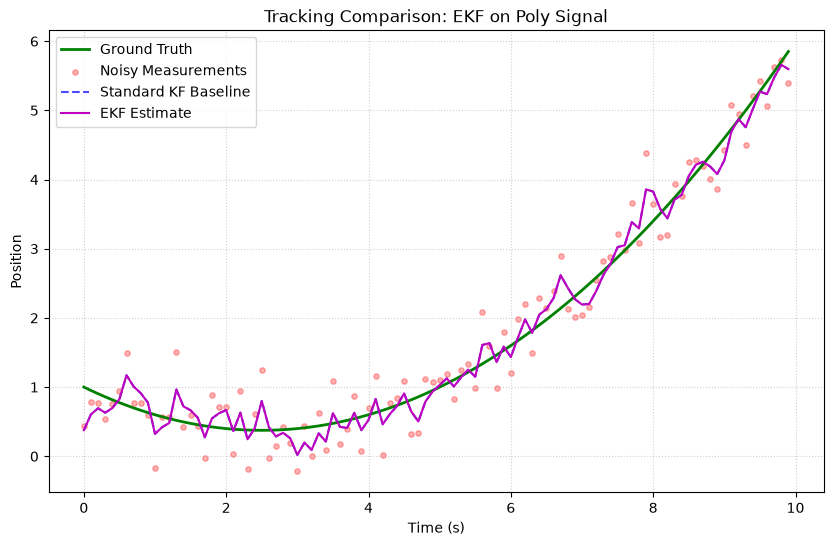
- Analysis: The EKF tracks the quadratic curve with the same steady-state lag as the baseline KF, confirming that the linearization step behaves correctly under linear models.
3. Random Walk Signal
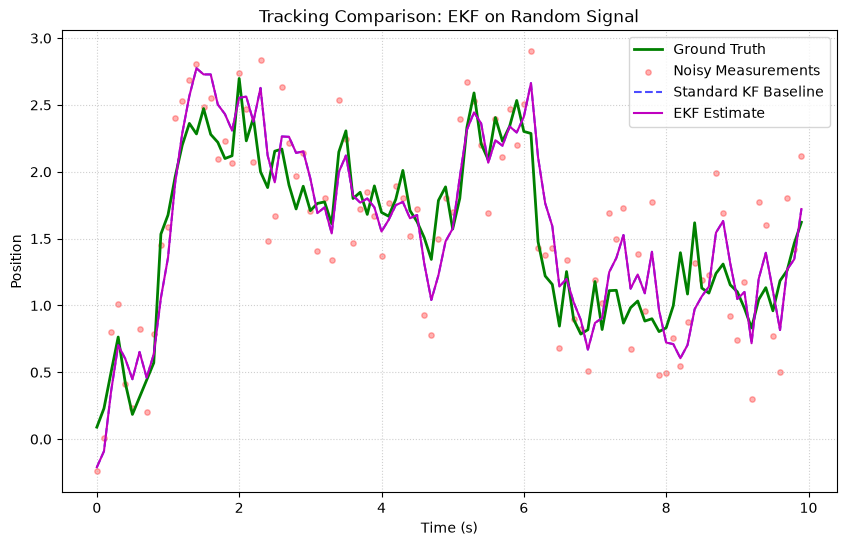
- Analysis: The EKF path is superimposed on the standard KF baseline, demonstrating consistent smoothing performance for stochastic signals.