Vectorized Kalman Filter (VKF)
The Vectorized Kalman Filter (VKF) is a high-performance implementation of the linear Kalman Filter optimized for tracking a large batch of independent targets simultaneously.
By leveraging NumPy's batched matrix multiplications, it avoids Python loop overhead and scales efficiently to thousands of concurrent filters.
Tensor Shapes
Unlike standard filters that expect 2D vectors and matrices, the Vectorized Kalman Filter operates on 3D tensors:
- State (\(x\)): Shape
(batch_size, n, 1) - Covariance (\(P\)): Shape
(batch_size, n, n) - Transition Matrix (\(F\)): Shape
(n, n)or(batch_size, n, n) - Process Noise (\(Q\)): Shape
(n, n)or(batch_size, n, n) - Measurement Matrix (\(H\)): Shape
(m, n)or(batch_size, m, n) - Measurement Noise (\(R\)): Shape
(m, m)or(batch_size, m, m)
Mathematical Implementation
The prediction and update steps use NumPy's @ operator, which naturally broadcasts over the first (batch) dimension:
Predict Step
Where \(F^T\) for a batched 3D tensor is computed via np.swapaxes(F, -1, -2).
Update Step
Usage Example
import numpy as np
from kalbee import VectorizedKalmanFilter

batch_size = 1000  # Track 1000 targets at once
state = np.zeros((batch_size, 2, 1))
covariance = np.repeat(np.eye(2)[np.newaxis, :, :], batch_size, axis=0)

F = np.array([[1.0, 1.0], [0.0, 1.0]])
Q = np.eye(2) * 0.01
H = np.array([[1.0, 0.0]])
R = np.array([[0.1]])

# Initialize filter with expanded matrices
F_batch = np.repeat(F[np.newaxis, :, :], batch_size, axis=0)
Q_batch = np.repeat(Q[np.newaxis, :, :], batch_size, axis=0)
H_batch = np.repeat(H[np.newaxis, :, :], batch_size, axis=0)
R_batch = np.repeat(R[np.newaxis, :, :], batch_size, axis=0)

vkf = VectorizedKalmanFilter(state, covariance, F_batch, Q_batch, H_batch, R_batch)

# Predict & Update in a single operation
vkf.predict()
measurements = np.random.randn(batch_size, 1, 1)
vkf.update(measurements)

print("Batch States Shape:", vkf.state.shape)       # (1000, 2, 1)
print("Batch Covariances Shape:", vkf.covariance.shape) # (1000, 2, 2)
Simulation Results
Here is the tracking performance of the Vectorized Kalman Filter (VKF) compared against the Standard Kalman Filter baseline on three different signal trajectories:
1. Sine/Cosine Signal
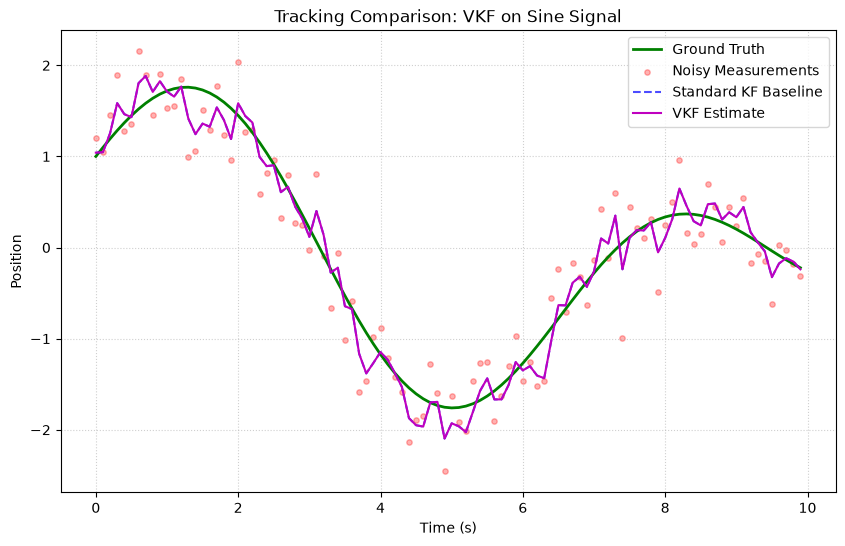
- Analysis: The VKF processes states in batched tensor forms. For a batch size of 1, it reproduces the Standard KF baseline estimates exactly.
2. Polynomial (Degree 2) Signal
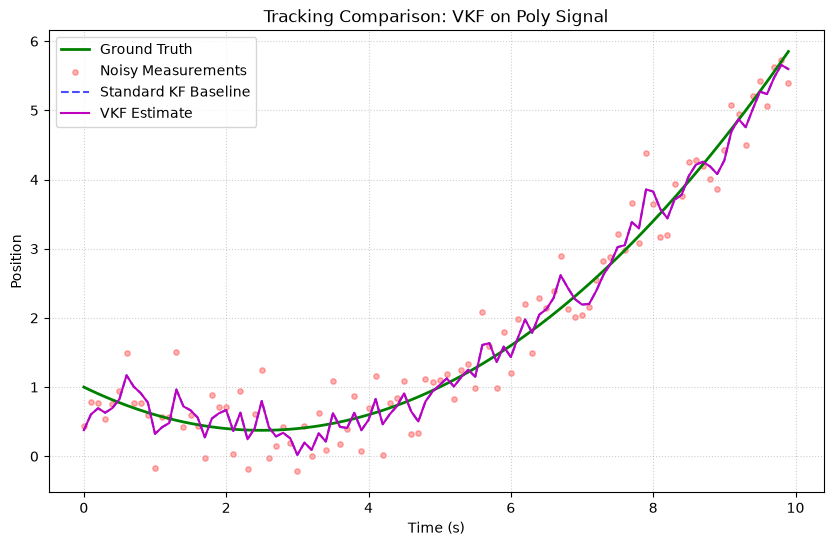
- Analysis: VKF tracks the quadratic curve with the same constant-velocity steady-state lag, verifying the correctness of the batched matrix math formulas.
3. Random Walk Signal
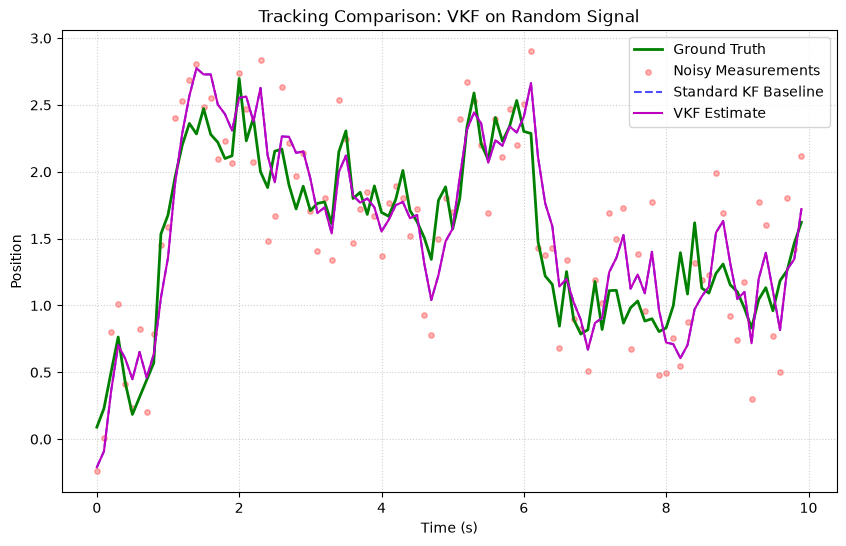
- Analysis: Matches the standard KF baseline precisely, demonstrating that VKF scales the same estimation capabilities across parallel target arrays.